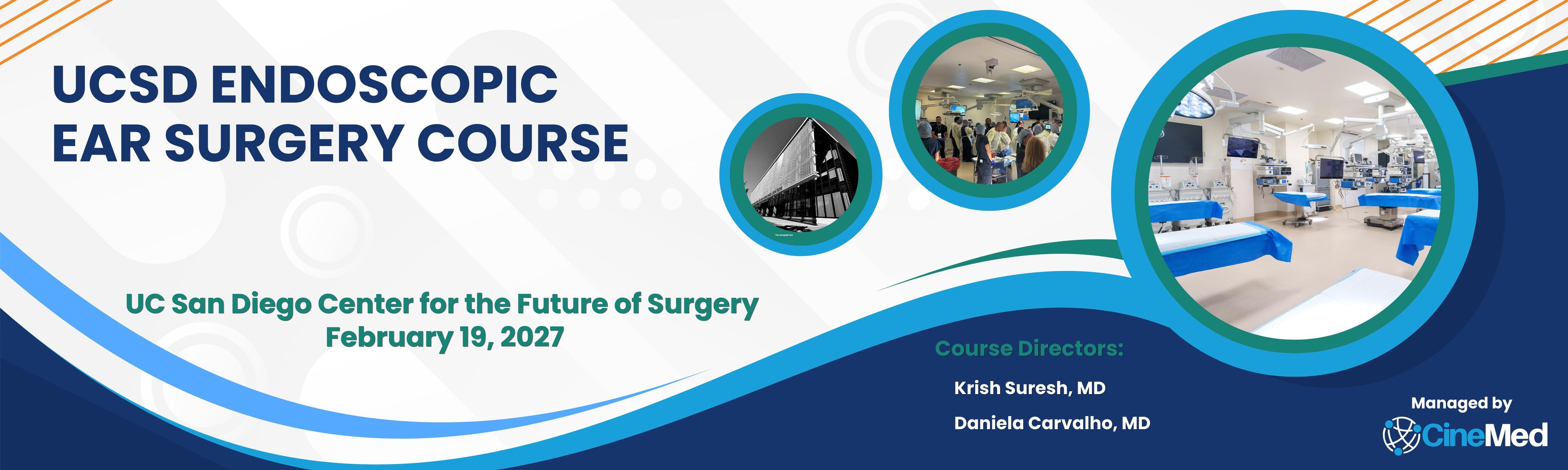
UCSD Endoscopic Ear Surgery Course
The UC San Diego Endoscopic Ear Surgery (EES) Hands-on Course is the first course of its kind at UC San Diego and one of the first on the West Coast. It is a 1-day program combining expert lectures, recorded surgical demonstrations, and supervised hands-on dissection at the UC San Diego Center for the Future of Surgery. The course teaches the principles, anatomy, instrumentation, and techniques of endoscopic ear surgery, from basic tympanoplasty to cholesteatoma management and advanced approaches. The keynote faculty member is Professor Daniele Marchioni, a pioneer of the field. He heads the Department of Otorhinolaryngology–Head and Neck Surgery at the University Hospital of Verona, Italy, and he is a founding member of the International Working Group for Endoscopic Ear Surgery (IWGEES).
WHEN
Friday, February 19, 2027
WHERE
UC San Diego Center for the Future of Surgery | MET Building, 9500 Gilman Dr, La Jolla, CA 92093
Limited Seats, Maximum Impact
Spots are capped at just 24 to maximize hands-on time, faculty access, and surgical skill development in a focused, high-touch learning environment.
Don’t wait to claim your seat — apply now.
Target Audience
This course is designed for board-certified or board-eligible otolaryngologists, as well as otolaryngology–head and neck surgery Residents and Fellows seeking to advance their knowledge and technical skills in Endoscopic Ear Surgery (EES).
A basic otologic surgery foundation is recommended, but no prior experience with endoscopic ear surgery is required. The course is particularly suited for clinicians interested in the principles, anatomy, instrumentation, and techniques of EES, ranging from basic tympanoplasty to the management of cholesteatoma and advanced endoscopic approaches.

Why this course is different than traditional didactic EES courses.
- Access to a pioneer. Professor Marchioni helped develop the anatomical and physiological concepts behind exclusive transcanal endoscopic approaches. He also published the first international book on endoscopic treatment of middle and inner ear disease and lateral skull base lesions. Few surgeons in the U.S. have the privilege to train with him directly.
- Filling a regional gap. Most EES courses are held in Europe or on the US East Coast. Many local and regional otolaryngologists have never been able to attend one.
- World-class facility. The Center for the Future of Surgery is a dedicated high-tech surgical training and innovation center with cadaveric workstations, high-definition endoscopy towers, and video integration.
- Low faculty-to-participant ratio. 1:6 Learner-to-Faculty Ratio ensures personalized, supervised instruction.
- Pediatric and adult perspective. Faculty will cover the full range of patients.
Learning Objectives

At the completion of this activity, participants should be able to:
- Describe the endoscopic anatomy of the middle ear, including hidden recesses and ventilation pathways.
- Set up and use endoscopic equipment safely and ergonomically, including heat and bleeding management.
- Perform transcanal endoscopic tympanoplasty and ossiculoplasty on a [cadaveric/model] specimen.
- Apply endoscopic techniques to cholesteatoma removal, including combined endoscopic–microscopic approaches.
- Identify appropriate indications, limitations, and patient selection for EES in adults and children.
- Build a plan for introducing EES into one’s own practice.
Countdown to the UCSD Endoscopic Ear Surgery Course
- Days125
- Hours15
- Minutes15
- Seconds57